TADs
Temporary Anchorage Devices — tiny titanium screws that enable tooth movements previously impossible without surgery.
Free Consultation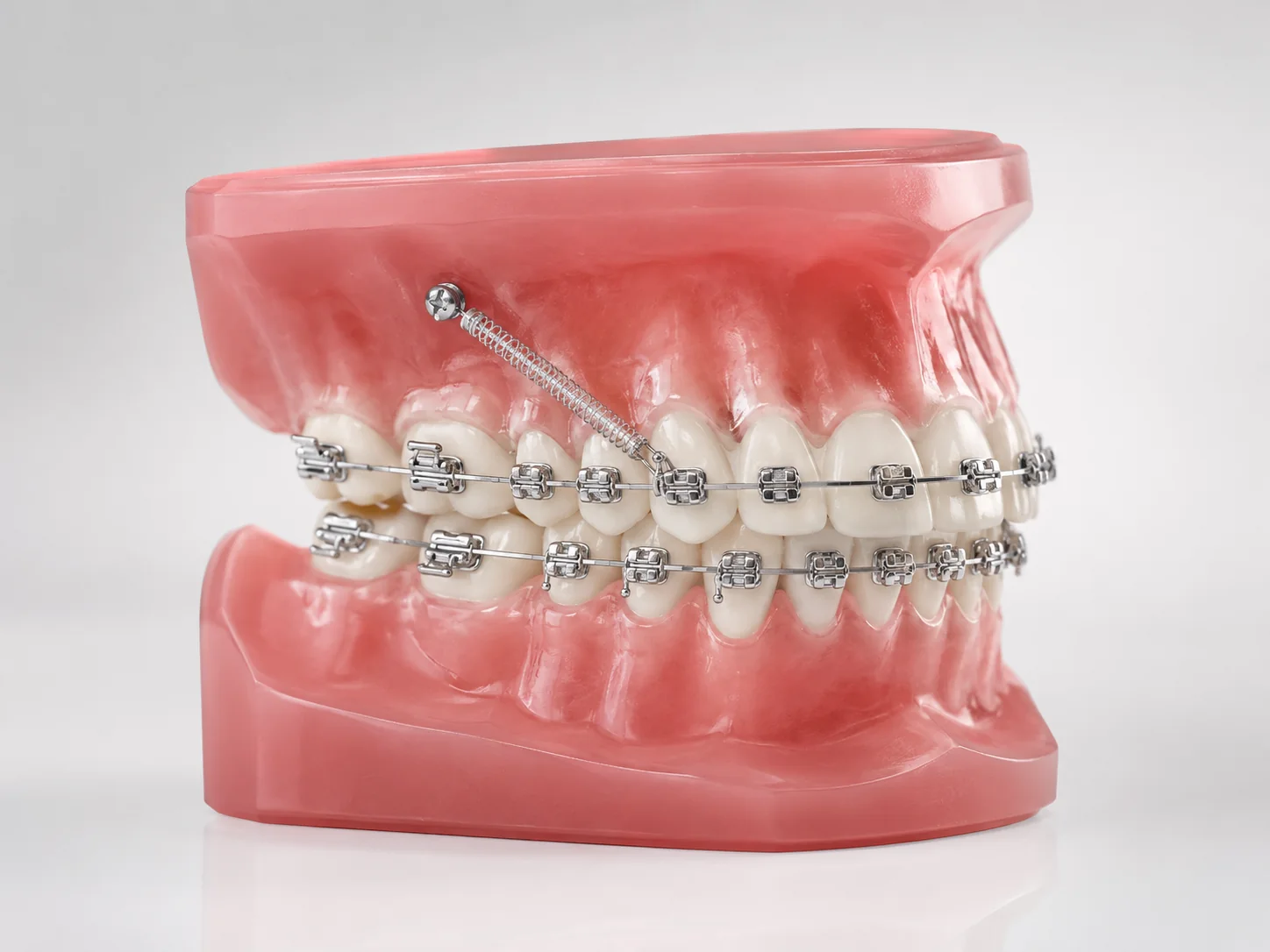
What are TADs?
TADs (Temporary Anchorage Devices) are small, biocompatible titanium screws that serve as fixed anchor points during orthodontic treatment. They're placed directly into the jawbone and provide a stable foundation from which to move teeth — movements that would otherwise require headgear, extractions, or surgery.
Think of TADs as giving us a "fixed point" to push or pull teeth. Without TADs, moving one tooth often means other teeth move too. With TADs, we can move specific teeth exactly where we want them while keeping other teeth stationary.
What Can TADs Accomplish?
Intrusion
Moving teeth up into the bone to level the bite or correct a gummy smile.
Protraction/Retraction
Moving entire sections of teeth forward or backward to close spaces or correct overjet.
Uprighting
Straighten tilted molars to prepare for implants or bridges.
Open Bite Correction
Intruding the back teeth to allow the front teeth to come together.
Benefits of TADs
- Avoid Surgery: Achieve complex movements non-surgically
- Eliminate Headgear: No need for bulky, visible headgear
- Avoid Extractions: Create space without removing healthy teeth
- Precise Movements: Target specific teeth without affecting others
- Shorter Treatment: Can reduce overall treatment time for complex cases
- Better Results: Achieve outcomes previously not possible
The TAD Procedure
Getting TADs placed is a quick and comfortable procedure:
- Numbing: A small amount of topical anesthetic is applied, sometimes with local anesthetic
- Placement: The tiny screw (about the size of a grain of rice) is gently placed through the gum into the bone — this takes only seconds
- Immediate Use: TADs can often be used the same day they're placed
- Removal: When no longer needed, TADs are easily removed in seconds with no anesthesia
What to Expect
- Pain: Most patients report little to no discomfort during or after placement
- Healing: No healing time required — we can attach wires or elastics immediately
- Care: Brush gently around the TAD to keep it clean. The main cause of TAD failure is poor oral hygiene
- Duration: TADs remain in place for several months to over a year, depending on treatment needs
- Success Rate: Over 90% of TADs remain stable throughout treatment when placed properly
Just seconds per TAD
About 1.5mm wide and 6-10mm long — smaller than a pencil eraser
"Does it hurt?" — Most patients say placement feels like minor pressure with no significant pain.